Halloween brings out the best and the worst of us as obsessive moviewatchers. I can only speak for myself, but I imagine my experience mirrors many of yours. When October rolls around (now mid-September because the 31 horror movies in 31 days doesn’t jive with adult schedules), horror movies dominate all channels. The wife shrugs her shoulders. Hide the more explicit DVD cases from the kids. You start arguing about sequels and franchises and Argento vs. Bava vs. Fulci.
My wife joins in when I can find a nice, palatable mid-grade horror film. In recent years, she’s joined me for films like Tremors and The Fog and comedies like The Ghost and Mr. Chicken. (Though, she still tells me she’s nervously scanning the mist for ghost pirates whenever a nice fog rolls through the Pittsburgh hills.)
Each year for the past four years, I’ve embarked upon the journey to watch at least 31 horror movies by the end of October. Last year I joined @ElCinemonster’s Hoop-Tober challenge on Letterboxd.com. Each year he lays down a few challenges to help guide the viewing of his monstrous minions. This year I’m again combining my Cinema Shame Horror Shame-a-thon with the Hoop-Tober Challenge 4.0 to perpetuate the most unwieldy title in the history of movie blogging and watching.
Welcome to the @CinemaShame/Hoop-Tober Watchpile/Shame-a-thon 31 Days of Horror 2017
Let’s lay down some rules for any lunatics that might want to play the home version of the 31 Days of Horror 2017.
Pick 31 never-before-seen (or unwatched DVD purchases) horror movies — “horror” is broadly defined as anything containing elements of the horror genre. So, for example, I’ve count the Abbott & Costello monster films in the past because of the classic movie monsters. Watch as many as you can stomach during your “month” of October.
I’m air-quoting “month” because, as I mentioned earlier, I’m borrowing @ElCinemonster’s notion that we’re busy goddamn people and 31 days is just not a reasonable duration for busy people to watch 31 horror movies. He’s beginning his “month” on September 15th. I plan to do the same. I hit 33 last year(!) and while I don’t expect to top that total I aim to match.
I’m going to pluck as many movies as possible from my Watch Pile (any film I already own that hasn’t been watched). I’ve been making a more concerted effort to watch more movies than I buy. The worthy remain. The ones I don’t see myself watching again hit eBay. I’ll note the outcome of each disc in my blurb.
And speaking of blurbs… after each movie, I’ll toss up a mini-review and a 30Hz rating that will correspond to my review on Letterboxd.com. The review may or may not contain any actual insight. The reviews are the part of this project that will leave you a quivering pile of bloody goo. And now for the more specific Hoop-Tober demonic hurdles, courtesy of @ElCinemonster.
6 sequels (mix-and-match. 6 total)
6 countries
6 decades
6 films from before 1970
6 films from the following: Carpenter, Raimi, Whale, Browning, Craven, Tom Holland (mix-and-match, or all one)
3 people eating people (non-zombie)
1 Hammer Film
1 Romero film
1 terrible oversight aka OVERT SHAME! (use this link, filter out the films you’ve seen and picked the highest rated film from the list that you can get ahold of)
And 2 Tobe Hooper Films (There must ALWAYS be a Hooper film)
-review them all.(eek)
Clearly one film can satisfy multiple criteria. Viewing and reviewing will begin at 12:01am CST on Sept 15th.
I plan to call some audibles when spur-of-the-moment cravings strike, but here’s my blueprint for the 2017 31 Days Of Horror CinemaShame/Hoop-Tober Watch Pile Shame-a-Thon.
What’s your list? What’s your plan for horror movie watching this year? If you’re keeping a list or participating in the Hoop-Tober challenge, I’ll link you in the header for my posts. Just leave a note with a link in the comments. Together we shall overcome… or we’ll be the loser pumped off in the first act to establish indomitable menace. It’s more comforting to know you’re not doing this alone.
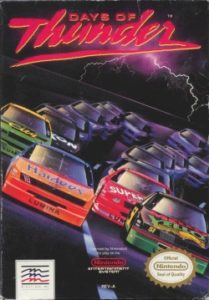
Released: October 1990 by Beam Software/Mindscape on the NES, C64 and PC. Gameboy in 1992.
The Australian developer Beam Software was responsible for a handful of licensed game titles in the NES and Genesis years including Back to the Future, Back to the Future II & III, and True Lies. I mention those titles specifically because there’s a fair chance we’ll be seeing Beam Software again in the near future.
As far as I can tell, Days of Thunder was only the second NASCAR game released for home consoles after Richard Petty’s Talladega (C64) in 1985. Without having played Talladega, I’ve got to believe this was at least a naturally progressive step forward in the genre as the cars in the former title appear to be squashed turtles on a remedial mini-golf course.
Days of Thunder’s October 1990:
Tim Berners-Lee begins work on the World Wide Web.
East and West Germany unify into a single Germany.
Mikhail Gorbachev is awarded the Nobel Peace Prize.
Janet Jackson released the 7th of 8 singles from her landmark album Rhythm Nation 1814 – “Love Will Never Do (Without You)”
Steven Seagal’s Marked for Death finished first at the box office for 3 out of 4 weekends in October 1990.
The Original:
Opening in June of 1990, Tony Scott’s Days of Thunder grossed $82million at the domestic box office, good enough for 13th place that year. Sandwiched between Presumed Innocent and Another 48 Hrs, the film performed modestly and was considered a relative failure… yet left a lasting impression of pre-pubescent boys everywhere. Most contemporary reviews reduced Days of Thunder to a Top Gun rehash, calling it “Top Gun on wheels” or similar. This owes, of course, to the film’s primary characteristic as a “Tom Cruise picture” which by 1990 had become a genre all of its own.
If I had to describe the “Tom Cruise picture” I’d break it down to a few basic components: a good-hearted but unbroken and rambunctious protagonist comes under the guidance of an elder mentor and must overcome an ersatz villain or false obstacles in order to test his mettle in a real-world scenario. See: Cocktail, The Color of Money, Top Gun. Also, someone probably dies.
While there’s plenty to criticize in Days of Thunder (dialogue, regurgitated narrative, stock characters), there’s also a lot of fun to be had… with a few concessions. Even in 1990, Days of Thunder felt like a silly bit of Hollywood fluff. Time has not improved that perception; it has, however, given us time to better appreciate the silly bits of Hollywood fluff that the industry churned out during the latter part of the 1980’s and early 1990’s.
These years represented the beginning of the star-vehicle decline and the last years that mid-budget action films retained a large segment of the box office. By 2000, studios had readjusted their focus to tent-pole blockbusters. Looking back, I harbor much nostalgia for this era of filmmaking — a time when films aimed to entertain without exceptionally lofty aspirations toward global omnipresence. I’d argue (perhaps futilely) that this style of filmmaking most closely resembles the 1930’s and 40’s, when Hollywood groomed star personas and often traded in face-value entertainment.
Days of Thunder subscribes to that variety of flash and glam spectacle led by the dictionary definition of a movie star in his prime. The romanticized roar of the engine. Sun glistening off freshly-painted automobiles. Narrative reduced to the fire of competitive spirit. Great fun — if you approach the film with the right mindset.
Looking to find defenses of the film across the web, I stumbled upon this blurb from none other than Quentin Tarantino:
Yeah, yeah, you laugh but seriously I’m a big fan. To me Days of Thunder is the movie Grand Prix and Le Mans should have been. Sure, it had a big budget, big stars and a big director in Tony Scott, but it had the fun of those early AIP movies. I just don’t think it works if you take the whole thing too seriously.
Days of Thunder fan Quentin Tarantino
Days of Thunder Gameplay:
Like the film, you, the inexperienced Cole Trickle, have been hired to drive the #46 City Chevrolet. Victory means winning the Winston Cup over your closest rivals Russ Wheeler and Rowdy Burns. Failure means therapy for sad Cole Trickle.
You begin the game at Daytona Beach. As you might expect any NASCAR inspired game involves cars going around and around and around a big oval. The only break in going around and around and around the big oval is when you need to pull into the pits for repairs and gasoline.
Remember when in the Top Gun video game adaptation when you repeatedly failed to land your F16 on the aircraft carrier? It’s a lot like that. In Days of Thunder you can pit improperly which results in a total fly by. Meanwhile you’re screaming at blocky collection of pixels to fill your gas tank or light themselves on fire. It’s a totally healthy mindset.
Once I figured out how to pit, I had a little bit of fun with this. And by “little,” I mean I didn’t throw the game through the stone blocks in my basement. Take that for what you will.
Pitting involves slamming on the breaks and holding B when you see the “PITS” sign, which abruptly appears along the stretch. Without a quick Google search I could not have figured this out. Even with this information, however, the first few times were complete misfires.
At last you arrive in the pit and now you must control the pit crew. Again with no idea what’s going on, you and the pit crew will just sit there shrugging. You have to jack the car up by pressing B. BUT WAIT! You have to have the correct crew member selected otherwise nothing happens. Once you get the car jacked up, you have to select the next guy to fix the tire. But don’t make him fix the tire too hard or he’ll put the bad tire back on again. Beat yourself with the tire iron, buddy. Once that side’s done you have to take your jack guy all the way around to the other side of the car to repeat the process. Because you have to control every action, pitting feels like half of the entire game. Eventually you’re back on the track.
Hit 3 o’clock on your tachometer and let your car purr, avoiding walls and other cars. God forbid you should actually bump another car because then your engine will break and you’ll have to pit again. I managed to survive Daytona Beach and advance to the second track, Atlanta, after about an hour of play time. By the time I reached Atlanta I’d lost all patience for turning left and yelling at my pit crew to do more than one job at a time so I gladly removed the Days of Thunder cartridge and moved on with my day.
My Gameplay Video:
When I recorded this video, I decided I wanted it to end sooner rather than later because the only thing more boring than playing a driving game that involves endless loops is watching someone playing a driving game with endless loops. I ended the suffering by not pitting so you can all witness sad Cole Trickle in real time. I also subbed in the original score for the 8-bit bleeps and bloops. You’re welcome.
.
Difficulty:
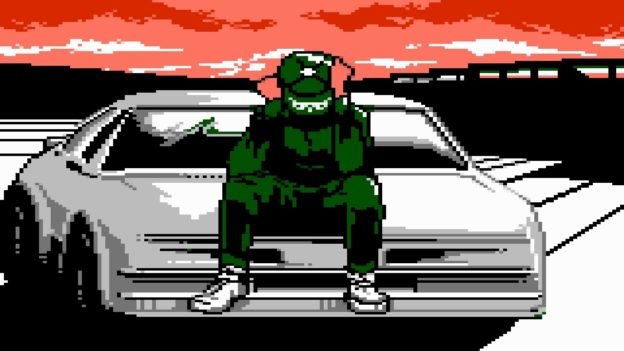
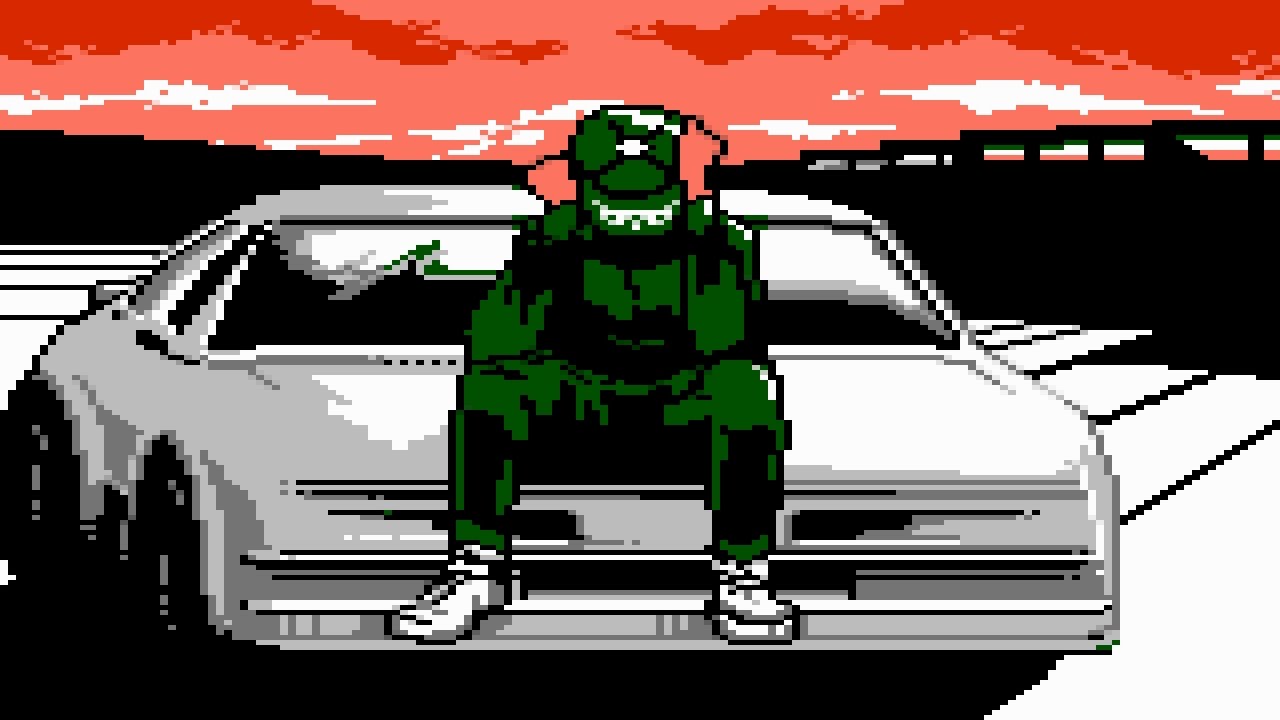
This game is hard. Beginners won’t likely make it out of Daytona. After a couple of failed pitstops, they’ll rip the game out of the console and never look back. Once you figure out the tachometer and acceleration mechanics and the pitting issue you’ll have a chance to finish a race. Not win — just finish. You’ll still try four more times after that, Your reward? A bigger track with twice as many laps and a slightly different color palette. UGH. (Did I mention that there’s a “glitch” in the game that makes it impossible to win one race? I’m not even joking.) Most likely you’ll see that aforementioned screen featuring sad panda Cole Trickle over and over and over and over:
.
Innovation:
Days of Thunder (NES) does add the mystique of a season-long simulated battle for the cup. It’s limited, of course, by the lack of the NES to save progress. Remember the Castlevania codes to return to an in-progress game? Junior cryptography training. The illusion of organic storytelling within the NASCAR season has its charms — except that you’ve likely seen the movie and know how this is all “supposed” to play out and goddammit the Tom Cruise charisma can’t be rendered in 8-bits.
The Modern and Wisened 30Hz Judgment:
Modern gamers would have no patience for this nonsense. in 2011 an updated version of the game appeared on the Playstation 3 and Xbox360 consoles. Critics said the game lacked any attention to real world detail or driving physics. At least you didn’t spent half the game in the pit. Developers still fell back on 21-year-old film branding to gloss over half-baked driving mechanics as if kids were still clamoring to experience the Cole Trickle shenanigans in pixellated form.
While the original Days of Thunder game does employ the brand to some advantage, this could have been a NASCAR simulation about any old Trickle — be it Dick or Cole. The fact is that old driving simulations don’t hold up (unless thy name is Gran Turismo) and this one was never any good to begin with. After 60-70 minutes of overall time spent with Days of Thunder, I was more than happy to put this cartridge back into the bin for misfit games and look forward to my next Licenced to Kill Challenge.
In the meantime, I might revisit some R.C. Pro Am or Rad Racer — NESracing games that, you know, don’t require you to STOP RACING after every four laps for a two-minute pit stop.
Verdict:
Give the Days of Thunder movie another chance with a modern, fresh perspective, but the game’s the pits.
Licensed to Kill returns in a couple of weeks when I once again consider the merits of a game that should have been forgotten. For each LICENSED TO KILL column, I’ll play another licensed game and revisit the corresponding film or source material. I’ll play the game for a minimum of an hour — no matter how excruciating that experience might be. You vote on the titles I play. I suffer the consequences.
As someone who constantly looks back on nostalgia with both loathsome wonderment and reverence, I’ve made an unofficial study of the balance between emotion and honest assessment. I can enjoy movies I know to be objectively bad because they meant something in my youth — they were vital components of my everyday existence. As our perspectives change, so too does the world around us.
Take for example Rocky IV, which I rewatched recently to prep for an upcoming Cinema Shame episode on the entire Rocky series. In 2017 this movie feels positively alien. It features a montage made up of montages and a “Can’t We All Just Get Along” Cold War plea.
In the late 1980’s, however, I watched Rocky IV on a regular loop. It wasn’t just the movie, though. It was the hushed buzz around the school when we talked about Ivan Drago killing Apollo Creed. It was that Russian crowd chanting Rocky’s name, our hero cloaked in an American flag, Survivor songs on an endless loop. A near-perfect calculation of sound and image — something I like to call synesthesia nostalgia.
Not coincidentally, Rocky Balboa has inspired video game titles as well, from 1987’s Rocky for the Sega Master System to 2002’s Rocky for the Playstation 2. The latter of which is actually a rather solid boxing sim. The former, well, we’ll likely tackle that in this bl-g at a later date.
No Nosta’algia
I’m hoping Al Bundy sports this t-shirt in a future episode of Married With Children. Shout out to Eric Jones (@deacon05oc on Twitter) for inspiring this Photoshop diddling.
Nostalgia plays an important role in our angsty, modern lives. It shackles us to our youth. It transports us to a time and place when the most pressing matter in our lives was figuring out how to find the damned Screw Attack in Super Metroid. As long as we can still see forward to the future while we huddle in our closets filled with nostalgic baubles, nostalgia protects a necessary escapism that neither time nor tide nor better judgment can erode.
There is, however, a dark commercial underbelly to nostalgia that we scrub away as necessary. For nearly as long as home video game consoles have been a thing, so too has the licensed video game. These are games that borrowed the title of a film or television property in order to move half-baked video games that relied exclusively on the popularity of the source material to sell units. For every Batman (NES) there twenty (likely more) Goonies II‘s (NES) or Cool Worlds (SNES). These games milked our emotional attachment for every single penny.
The still-born game received widespread criticism and largely contributed to the first crash of the video game industry in 1983. The populous graveyard of movie-licensed video games features so many forgotten and largely unplayable titles that even as I was researching potential games to discuss in this bl-g series, I found dozens upon dozens of games I never knew existed. And I must confess I played a lot of (terrible) games in the 8- and 16-bit eras. As a young movie junkie, I often fell into the trap of the licensed video game. I had yet to learn some very important lessons about soulless commercialism.
LICENSED TO KILL: An Introduction
In this bl-g series that I’ve titled LICENSED TO KILL, I want to resurrect some of these games and place them alongside their cinematic counterparts — recalling the moment in pop-culture history as best as my foggy memory can muster. For some of you this might also be a trip through your own nostalgia. For others, this might be your first exposure to the unseemly world of greed and duplicity located at the intersection of movies and video games.
Photo by Michael Work.
For each LICENSED TO KILL column, I’ll play another licensed game and revisit the corresponding film or source material. I’ll play the game for a minimum of an hour — no matter how excruciating that experience might be. In bl-g form, I’ll talk about the game, trying not to become the Angry Video Game Nerd, record some gameplay and share my experiences. The best part — for you, the reader anyway — is that you’ll get to pick the games I play. Every time I need a new game for a column, I’ll go to my local used game store (the Exchange here in Pittsburgh is my regular haunt) and tweet out a new poll based on the video games available in the cabinet. After fifteen minutes the top vote getter walks out of the store with me.
Methods to Madness
All games will be played on the Retron 5 game system with the original console controllers. I’d have insisted on the proper console experience but I no longer have a working CRT television with necessary analog inputs for all my old game systems. So it goes. Recorded gameplay will come from an emulator and QuickTime video recording on my laptop.
In a few weeks, my first column will feature Days of Thunder (NES) and will tie into to the #Bond_age_ Days of Thunder live tweet on August 30th. How better to celebrate a Days of Thunder licensed video game by tying it all together with a modern live tweet of the film. A successful cross-promotion for everybody and by everybody I mean me. And by success, I mean I get to spend more time typing words that someone will read.
Let’s see if any of these games are still worth playing in 2017 or if they should all be dumped back in the landfill of forgotten cash grabs. I hope you’ll enjoy the series more than I enjoy playing the games. Having already dabbled in Days of Thunder for a couple of hours, I don’t see how any other outcome is possible.




 Days of Thunder (NES)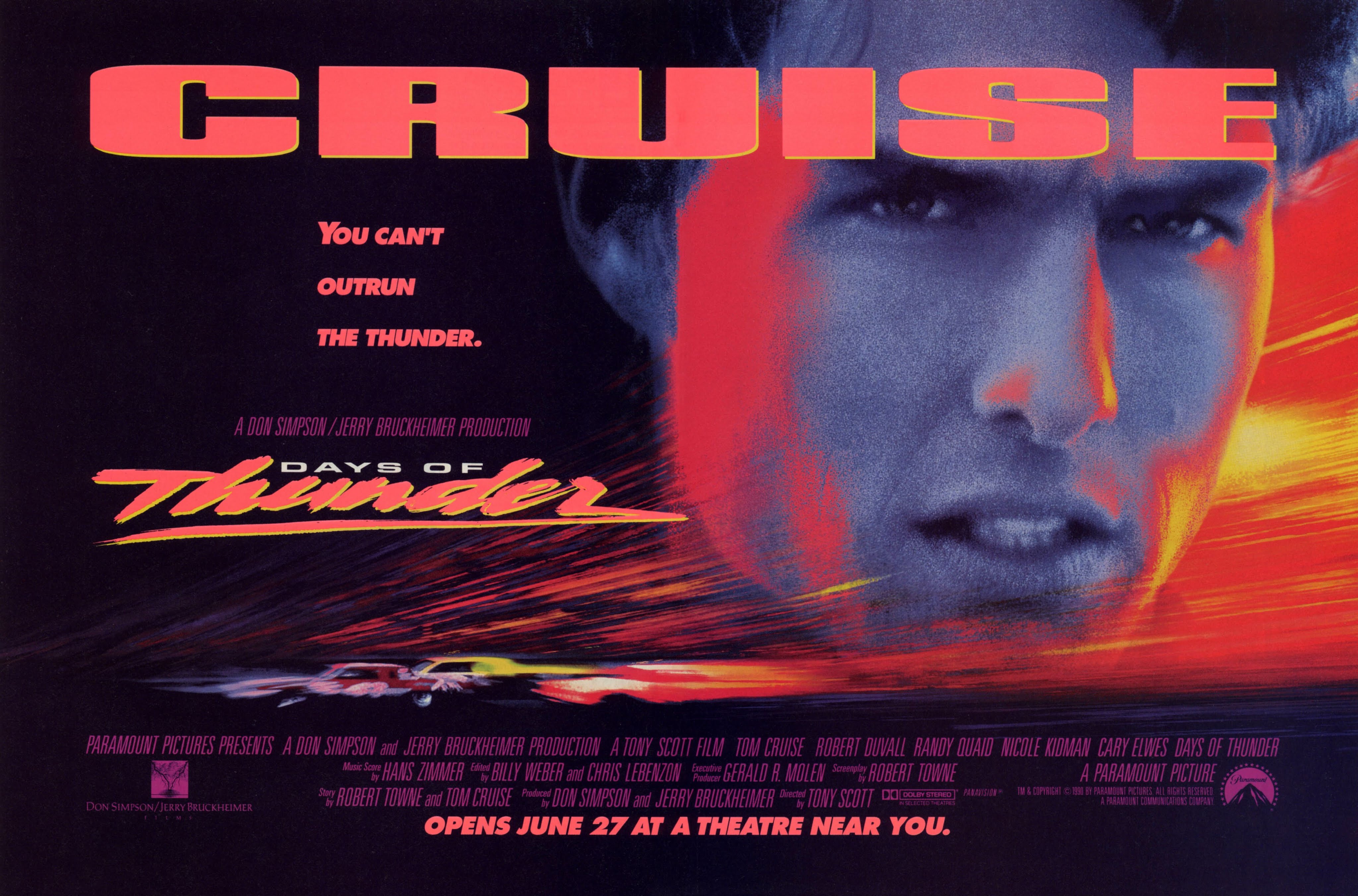





 And, of course, you’ve likely heard the story about