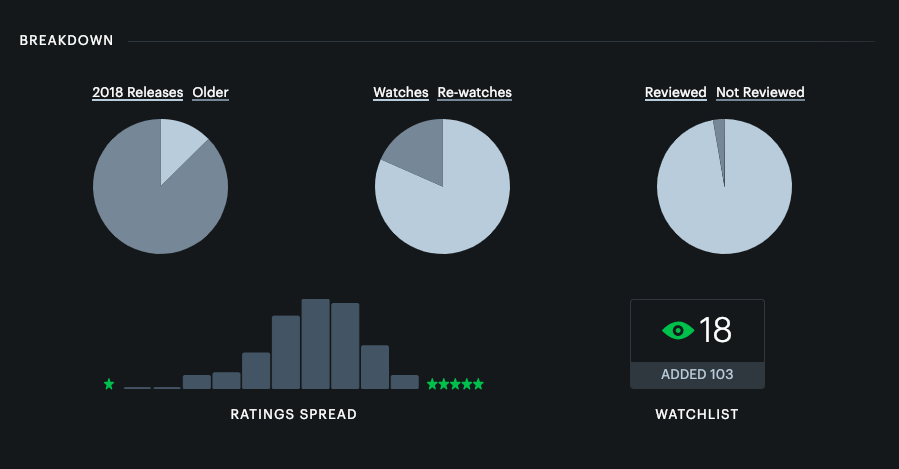
My Letterboxd stats sheet suggests I watched about 293 new movies in 2018 (give or take a few that I forgot to log along the way). Of those 293 new movies, 239 were brand new-to-me watches. From King Arthur in the wee hours of the new year to our New Years Eve viewing of Blockers. If you’re in need of more interesting footnotes about my year in moviewatching (like Christopher Lee appeared in 6 different movies, and I watched 23 different French movies in 2018) jump on over to my Letterboxd account.
While everyone was out there discussing A Star Is Born, Black Panther and some other movie that didn’t really do it for me, I was probably watching through Louis Feuillade’s filmography. That sounds very #OldMovieWeirdo. I’m lobbying for guild membership this year. For the 4th year in a row, I’ve created my own awards ballot because I don’t feel like I’m all that qualified to competently discuss the real Academy Award nominations — I am, however, qualified to give arbitrary accolades to the 293 movies I did watch.
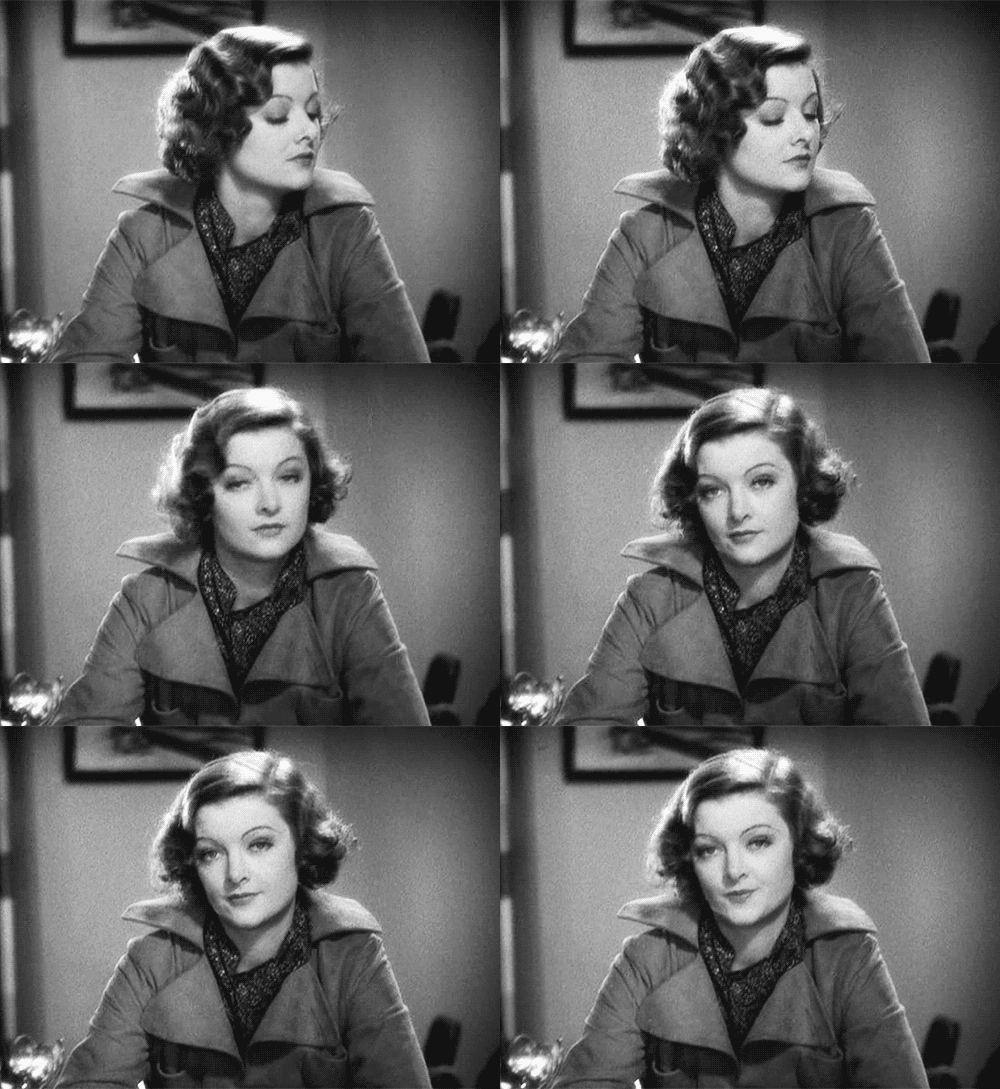
And while the Academy Awards still don’t really have a host lined up for the ceremony, I can always count on my mistress of ceremonies, Myrna Loy, to take up the microphone and give Hertzie readers their money’s worth.
Now presenting the 4th Annual First-Watch Hertzie Award Nominations.
Favorite Supporting Actress:
Ann Dvorak, Scarface Mia Goth, Suspiria Nastassja Kinski, Paris, Texas Laurie Metcalf, Lady Bird Lois Smith, Five Easy Pieces Rachel Weisz, The Favourite
Commentary: Surprise nomination for Ann Dvorak causes a stir. Voters claim she’s never been better, but still — was that reason to include her in the same category as as these other ladies?
**WINNER** – Nastassja Kinski, Paris, Texas
Favorite Supporting Actor:
Charles Durning, The Best Little Whorehouse in Texas Tom Courtenay, A Dandy in Aspic Ethan Hawke, Juliet, Naked Christopher Plummer, Silent Partner Jason Robards, Once Upon a Time in the West Jack Warden, Heaven Can Wait
Commentary: Charles Durning soft-shoes his way to a nomination. Ethan Hawke wonders if he got nominated for the wrong movie.
**WINNER** – Charles Durning, The Best Little Whorehouse in Texas
Favorite Actor
Richard Dreyfuss, The Big Fix Peter Falk, The In-Laws Henry Fonda, The Ox-Bow Incident Jeff Goldblum, Vibes Laurence Olivier, Wuthering Heights Harry Dean Stanton, Paris, Texas
Commentary: Voters cite Jeff Goldblum’s ability to act alongside Cindi Lauper as proof that he could do anything — and deserves to be in the same category as Laurence Olivier, Henry Fonda, and Peter Falk. Richard Dreyfuss is just happy anyone remembers The Big Fix.
**WINNER** – Harry Dean Stanton, Paris, Texas
Favorite Actress
Isabelle Adjani, Possession Tony Collette, Hereditary Marion Davies, Show People Lily James, Mamma Mia: Here We Go Again Vicky Krieps, The Phantom Thread Merle Oberon, Wuthering Heights
Commentary: Early buzz has Isabelle Adjani running away with this category, but the inclusion of Lily James and Marion Davies has renewed talks of a required pre-ballot voter drug-test. Nevertheless, voters claim Lily James radiated ‘movie star’ in a surprisingly good sequel.
**WINNER** – Isabelle Adjani, Possession
Favorite Adapted Screenplay
Closely Watched Trains – Jirí Menzel Juliet, Naked – Tamara Jenkins, Jim Taylor, Phil Alden Robinson, Evgenia Peretz Night of the Demon – Charles Bennett, Hal E. Chester Paper Moon – Alvin Sargent Silent Partner – Curtis Hanson Wuthering Heights – Charles MacArthur, Ben Hecht
Commentary: Ethan Hawke’s still wandering around the lobby asking everyone if they watched First Reformed.
**WINNER** – Paper Moon – Alvin Sargent
Favorite Original Screenplay
Big Deal on Madonna Street – Agenore Incrocci, Furio Scarpelli, Susan Cecchi d’Amico, Mario Monicelli Brigsby Bear – Kyle Mooney, Kevin Costello Five Easy Pieces – Adrien Joyce The In-Laws – Andrew Bergman Paris, Texas – L. M. Kit Carson, Sam Shepard Peeping Tom – Leo Marks
Commentary: Kyle Mooney asked to be seated at Sam Shepard’s table, but Sam Shepard in turn requested that Mooney’s seat be occupied by a bottle of whiskey.
**WINNER** – Brigsby Bear – Kyle Mooney, Kevin Costello
Favorite Director
Jacque Becker, Le Trou Alfred Hitchcock, Lifeboat Sergio Leone, Once Upon a Time in the West Jacques Tourneur, Night of the Demon Wim Wenders, Paris, Texas Andrzej Zulawski, Possession
**WINNER** – Sergio Leone, Once Upon a Time in the West
Favorite Picture
Big Deal on Madonna Street (1958) Closely Watched Trains (1966) Mission: Impossible – Fallout (2018) Once Upon a Time in the West (1968) Paris, Texas (1984) Stop Making Sense (1984)
Commentary: Rebecca Ferguson promised to attend in her Rogue Nation dress if Mission: Impossible got a Favorite Picture nomination. Only explanation.
**WINNER** – Stop Making Sense (1984)
Favorite “B” Picture
3615 code Père Noël (1989) Captain Kronos Vampire Hunter (1974) A Dandy in Aspic (1968) Night of the Demon (1957) Possession (1981) Silent Partner (1978)
Commentary: Nobody really has any clue what fits this category so the nominees just get tequila shots until one remains standing.
**WINNER** – Possession (1981)
Good luck to all of our 2018 Hertzie Award Nominees! The winners will be announced the evening of the 2019 Academy Awards on February 24th.
Just when I thought I wasn’t enamored with the music of 2018… I compiled my Best Songs of 2018 list and realized, well… that I wasn’t that enamored with the music of 2018. I fell at the feet of a few select albums and those albums consumed my year. My love for Arctic Monkey’s Tranquility Base Hotel & Casino forced me to re-evaluate the entire Arctic Monkey’s catalog. (It’s better than I remembered!) Of course I had a new CHVRCHES record, so I even had to grapple with my steadily increasing CHVRCHES fanboy tendencies (I’m incorrigible.)
Overall, however, 2018 was another year filled with highs and lows, just like any other. Even though popular culture continues to tout rap’s new directions, I can only shrug because what the hell is that even? What happened to beats, rhymes & life? You guys aren’t even trying to rhyme and god forbid we introduce a decent beat. Indie rock has fallen back into an interminable mid-tempo cruising speed, proper rock & roll failed to leave a mark, and I even liked not one — but two country albums. (What?)
At the outset I made an effort to digest a wider variety of music styles. As a result I spent more time with soul, blues and modern jazz. Genres in which I tend to live in the past. Each year I tend to discover many great jazz records… made in the 1950’s. My list reflects those efforts in fits and spurts and I even found a few terrific jazz records made after 1960. (The hell you say.)
And now for my yearly disclaimer. I’m just one human listening to music and these selections reflect my year in music. I share my picks because maybe you’ll find some new favorites for yourself. I also carry on because my friend Michael Smith at bsidesnarrative.com have been exchanging lists every year since 2007.
Music sustains us through the tough times and improves the good ones. It gives us hope for the future and convinces us we’re more deep and soulful than we really are. Music is a constantly renewing life blood. Never stop listening to new music.
The minute you stop listening to new music is the moment you become old.
101. “Falling Into Me” – Let’s Eat Grandma
100. “Mice” – Billie Marten
99. “Birds” – The Shacks
98. “How Can I Love You” – Yellow Days
97. “True to You” – Deep Cuts
96. “We Appreciate Power” Grimes (feat. HANA)
95. “Anthem (To Human Justice)” – Logan Richarson
94. “Make Me Feel” – Janelle Monáe
93. “New Birth in New England” – Phosphorescent
92. “Foundation” – Public Practice
91. “The Bug Collector” – Haley Heynerickx
90. “Once In My Life” – The Decemberists
89. “Thread” – David Bazan & Kevin Devine
88. “The Walker” – Christine and the Queens
87. “Wild Blue Wind” – Erin Rae
86. “A Little Dive Bar in Dahlonega” – Ashley McBryde
85. “Everybody Wants to Be Famous” – Superorganism
84. “Bad Bad News” – Leon Bridges
83. “My Friend the Forest” – Nils Frahm
82. “Nearer My God” – Foxing
81. “Honeymooning” – Holy Motors
80. “It’s Alright” – Slow and Steady
79. “Lemon Glow” Beach House
78. “Meateater” – ALASKALASKA
77. “Tokyo Bay” – Nick Lowe
76. “Suspirium” – Thom Yorke
75. “better alone” – Lykke Li
74. “Straight Shot” – DeVotchKa
73. “Fireworks” – First Aid Kit
72. “MJ” – Now, Now
71. “Paper Trails” – Celebration
70. “Scream Whole” – Methyl Ethyl
69. “Egyptian Luvr” – Rejjie Snow (feat. Aminé and Dana Williams)
54. “Everybody’s Coming to My House” – David Byrne
53. “Blue Girl” = Chromatics
52. “Nobody” – Mitski
51. “Don’t You Know” -Durand Jones & The Indications
50. “Your Dog” – Soccer Mommy
49. “Semicircle Song” – The Go! Team
48. “Welcome to the Milk Disco” – Milk Disco
47. “Gold Rush” – Death Cab for Cutie
46. “Powder Blue / Cascine Park” – Yumi Zouma
45. “Don” – Ocean Wisdom
44. “Space Cowboy” – Kacey Musgraves
43. “List of Demands” – The Kills
42. “Far Behind You” – Lyla Foy (feat. Jonathan Donahue)
41. “Fallingwater” & “Light On” – Maggie Rogers
40. “Saturdays” – Twin Shadow (feat. HAIM)
39. “Modafinil Blues” – Matthew Dear
38. “This is America” – Childish Gambino
37. “Rosebud” – U.S. Girls
36. “Sense of Discovery” – Simple Minds
35. “Know My Name” – Das Body
34. “Jeannie Becomes a Mom” – Caroline Rose
33. “Late to the Fight” – LUMP
32. “Jeep Cherokee Laredo” – The War and Treaty
31. “Oh No, Bye Bye” – Sunflower Bean
30. “Confirmation” – Westerman
29. “Give Up” – I See Rivers
28. “How Simple” – Hop Along
27. “Can’t Do Better” – Kim Petras
26. “Honey” – Robyn
And now for my Top 25 portion of The Best Songs of 2018. Because I’m becoming more of a realist in my old age, I now recognize that nobody’s going to read 100 blurbs (we’re very busy Internet surfers). Instead of half-assing 100 blurbs, I’m only half-assing 25. You’re welcome.
“Heaven/Hell” – CHVRCHES (from the Hansa Sessions)
Just another song on CHVRCHES solid 2018 LP Love is Dead soared on this acoustic version with a blast of strings and stripped down vocals. It’s an entirely new song. Go ahead. Close your eyes, throw your head back and sing along. #NoJudgment
“Twanguero” – Electric Sunset
The search for new surf guitar artists usually proves futile. Spain’s Diego Garcia paid back that investment tenfold.
“Formless and New” – Rubblebucket
Psychedelic arty dream-poppers took the same old same old and added big beats, brass and pitchy synth to make something familiar but f#cking fresh as hell.
“Emily” – Clean Cut Kid
Easily the best cut from Fleetwood Mac in 2018.
“Eva” – HAERTS
Epic dream-pop in four movements.
“Roll (Burbank Funk) – The Internet
Irresistible California funk. Lush instrumentation, groovy bassline, and honey-dripped vocals.
“I’ll Make You Sorry” – Screaming Females
Punk-lite vets peak with their seventh record? Not saying they did, just saying it’s an argument you could make that wouldn’t be weird. Marissa Paternoster has the best name and warble in the business.
“Wide Awake” – Parquet Courts
Indie-rock Junkaroo.
“Peach” – Broods
Trippy, electro-pop from New Zealand has pinpointed your pleasure center with dreamy vocals over block-rocking beats.
“Short Court Style” – Natalie Prass
June Christy + Booker T. = “Short Court Style”
“Boss” – Little Simz
I haven’t been this enamored with a female rapper since Ice Cube gave the world Yo Yo in 1991. The rolling bassline will make you believe that you’ve got moves, too.
“Letting Go” – Wild Nothing
Wild Nothing’s sound perfectly distilled into one individual song. They’ll never be a more Wild Nothing song than the jangly, melancholic “Letting Go”.
“Strange Embrace” – Kitten
This poppy, hook-laden confection makes me purr.
“Night Shift” – Lucy Dacus
Swallow-your-soul storytelling with beautiful, tortured musicality. If you don’t know the name Lucy Dacus, you should get acquainted. Immediately.
“Future Me Hates Me” – The Beths
Riot grrls had a strong showing on the countdown because more so than any other 2018 microgenre the ladies recognized the power of a well placed guitar riff and a hooky chorus.
“Over the Midnight” – Jonathan Wilson
The first song added to my 2018 Hits List survived the gauntlet to earn a spot in the Top 10. Lush soundscape with Cat Stevens lyrical stylings.
“She Remembers Everything” – Roseanne Cash, Sam Phillips
Haunting strings and hooky, soul churning lyricism.
“Me and My Dog” – boygenius (Julien Baker, Phoebe Bridgers, Lucy Dacus)
If you would have said to me, “Jay, I charge you with creating the ultimate female singer-songwriter supergroup,” I would have chosen Julien Baker, Phoebe Bridgers and Lucy Dacus. Now that you mention it, I would have added Maggie Rogers, too, but who am I to quibble?
“Not Tonight” – Ten Fé
London duo’s irresistible candy-coated alt-rock. A Khan-worthy ear worm.
“May Your Kindness Remain” – Courtney Marie Andrews
Repeated refrains or song titles can become grinding and pretentious — or beautiful and meditative.
“Four Out of Five” – Arctic Monkeys
Until now I’d always lost the Monkeys’ lyricism among the bombast. Clever twists of phrase and irony have never been more lounge lizardy.
“Driving” – Grouper
I am a child It is a gift that my mother gave me
Watching the pavement Stretch out and fade You gave me
Along the highway They look to see The nature of the crash To see the body
And it is time We’re on our way I wonder Whether you realize How much I love you
Today, the land Is slightly wider than the sky
And we are driving Oh, life Life in the tunnel Made of the sun frame
“Helpless” – The Regrettes
Hamiltonian cover refashioned for hooky riot grrrlllllls with perfect pop sensibilities.
“Graffiti” – CHVRCHES
I won’t apologize for my Lauren Mayberry obsession — I stand by my assertion that this is some of her best songwriting.
“Love It If We Made It” – The 1975
I dismissed this song after first listen, but it’s off-kilter backdoor not-a-pop-song pop qualities wore me down until I couldn’t deny this band’s emerging greatness any longer. This is my best song of all the best songs of 2018 at this very moment. Check back tomorrow.
In July of 2002, Tom Hanks sat next to me at a round table in the conference hall of the Ritz-Carlton Chicago and talked about the particular demands of acting in comedies versus dramas. I asked this question because I’d been assigned the story, but I wasn’t especially interested in his response. It was, after all, being recorded on cassette tape. I could transcribe it all on the plane back home. Naturally he’d focused on the rewards of acting in dramatic fare (the specifics elude me all these years later) and the opportunity to act opposite Paul Newman. He said all the things he needed to say because Tom Hanks was (and still is, as far as I know) the consummate professional Hollywood actor.
Part of that consummate professionalism required him to promote his current film and say glowing, positive, effervescent things about Road to Perdition. The last thing anyone expected him to say was that this gig was merely the culmination of his master plan to create a gleaming, golden coffee table with Oscar-statue legs for his sitting room. Tom Hanks punched his time card like a pro; I had amateur stenciled across my forehead. I hoped I’d get to ask a second question before getting sandbagged by everyone else’s agenda.
Little did I know I was about to get sandbagged by my own agenda. I’d written for InSite Magazine for almost a year at this point. My editor took the choice assignments while I reviewed the latest Not Another Teen Movie or Ballistic: Ecks vs. Sever. Just a couple months earlier, my editor had handed me my first talent interview because, he said to the best of my recollection, “I handled bad movies with the respect they deserved.” I still have no idea if that was an actual compliment. As a 23-year-old writer who believed quite highly in himself and pined for any shred of (due) enthusiasm over my writing, I stitched that merit badge on my canvas messenger bag.
The interview? Quite predictably I’d been tasked with discussing a C-grade movie, albeit with a notable commodity. Fresh off Rushmore Jason Schwartzman made a pond dredge teen movie called Slackers. In case the “pond dredge” comment wasn’t leading enough, I’ll say it plain: Slackers stunk. When he made a joke about my Gap jacket, I’d been so focused on obscuring how much I hated the film that I failed to come up with any rebuttal.
I still regret the zinger I never made. I replace the tags so not to intimidate my interview subjects with the posh lifestyle of a tabloid-format journalist. Maybe not the ultimate burn, but still better than a nervous laugh that surely betrayed the fact that I took his crack about “having that same jacket” seriously for an embarrassing number of seconds. Welcome to the business, you’ve just been roasted by a snarky actor two years your junior. I just wanted to conduct the interview and vacate the hotel suite before someone faxed him my D-grade review. It also wouldn’t be the last time I regretted questions or thoughts left unsaid in an interview.
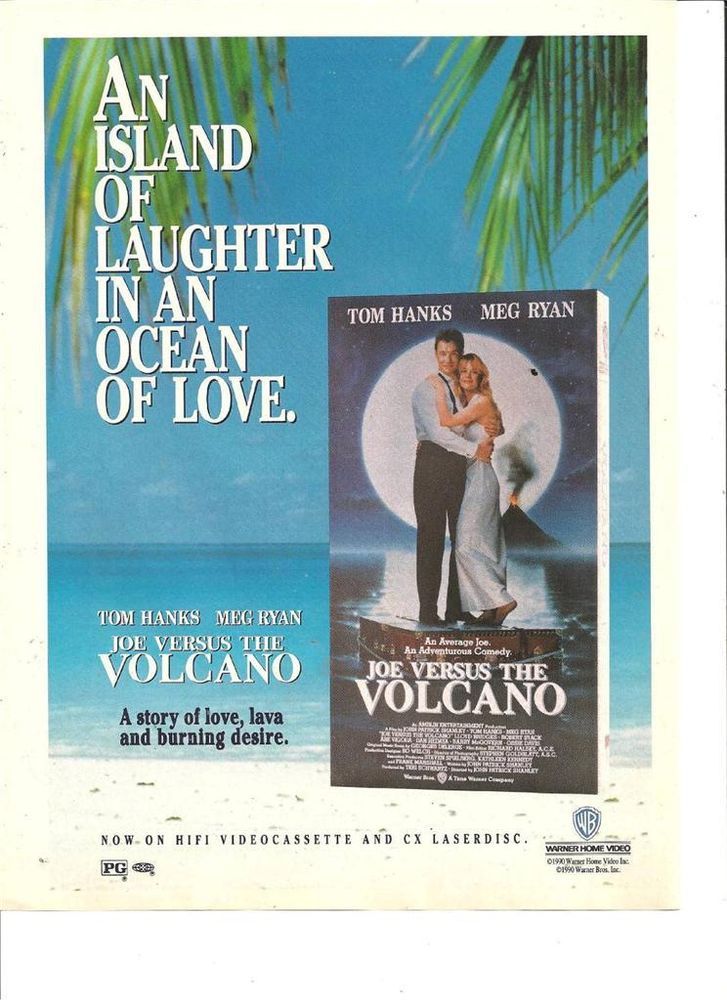
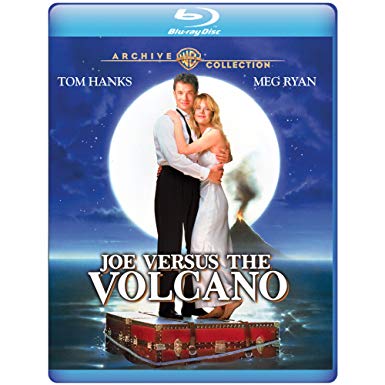
Determined to not repeat past failures, failed to hear the entirety of Mr. Hanks’ response before firing off a second question, or rather a leading statement, which was really the question I’d been dying to ask all along. I said, “I actually consider it a shame that you’ve turned your attention away from comedy because I consider Joe Versus the Volcano the most important movie you’ve made.”
He paused, befuddled perhaps, and regarded this petulant whippersnapper (as I’m sure Tom Hanks’ internal monologue uses words like “whippersnapper”) with some sense of dismay and concern, brow furrowed at a gently sloping 45-degree angle. Was I confused? Impaired? Should security be called? Who was I to suggest that some silly movie he made way back in 1990 was better than award bait like Philadelphia, better than Saving Private Ryan and Forrest Gump, better even than the movie we’d all just watched, which was the most impactful movie in the history of cinema for the duration of this particular gladhand? Surely I’d prefer to assuage his ego about his latest most important accomplishment.
Ultimately, he laughed and thanked me for the sentiment, but did not specifically address my claim about Joe Versus the Volcano before others around the table began lobbing their favorite comedies like holy hand grenades from the trenches, making sure the actor had duly noted each of their picks, all of which seemed like an entire career ago. Someone mentioned Splash and Bachelor Party. Big came up. One of the guys even dropped The Man with One Red Shoe. I’d love to recast the table with at least one woman (because equal opportunity memoirism matters) so we’ll say this hypothetical woman mentioned Joe Dante’s The ‘burbs because The ‘burbs is also terminally underrated and this fictional ‘she’ would have had the good sense to make mention of it.
Nobody else, however, corroborated or acknowledged my Joe Versus the Volcano sentiment.
As our time with the actor ended, and as Mr. Hanks stood to move on to the next table, I asked him to sign my Road to Perdition pressbook. I’d never asked anything of any of the dozen celebrities I’d interviewed. These were just men and women doing their jobs who also happened to be household names. We were just doing ours. Some of us even got paid for it, but nobody knew our names. All of the other on-screen talent I’d interviewed had duly reinforced their celebrity status. Lists of things that couldn’t be asked, warnings about certain lines of questioning, untimely entrances and unusual water concoctions in pitchers provided by personal staffmembers.
Tom Hanks fulfilled every fantasy about Tom Hanks — cordial and friendly and inclusive. He happily signed my pressbook and all others at the table. He treated each of us like old friends and then abruptly exited our lives. Yet he never calls. He never writes.
On my flight home I began to transcribe the interview and I finally stepped out from behind the glow of conversing with Tom Hanks. I recognized how deftly he’d sidestepped my comment about Joe Versus the Volcano by responding modestly and without haste, thereby inviting others to chime in and dilute the precision of the question. A diabolical counterattack. His lack of displayed ego, coupled with the enthusiasm of the gathered round table allowed my Joe Versus the Volcano comment to dissipate without a trace, much like the movie itself in March of 1990.
If Tom Hanks didn’t see beyond the lackluster box office numbers, the confused moviegoing masses, and the unshakable scarlet “B” for bomb; what hope did anyone else have? Did he not think as highly of it as I’d assumed? Who else out there saw Joe Versus the Volcano for what it really was? Surely he could see that the real bomb wasn’t Joe Versus the Volcano at all, but The Bonfire of the Vanities, which kindly supplanted Joe as the headlining disaster on Mr. Hanks’ resume.
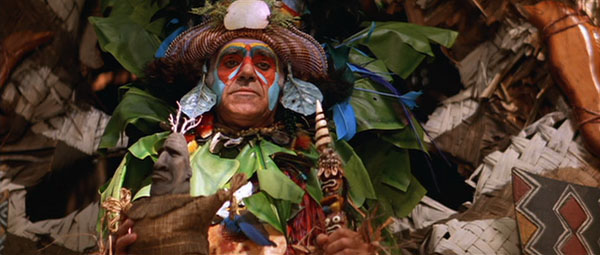
My mind raced with all the questions I didn’t ask, that I couldn’t ask. If only I’d had ten minutes to clarify his stance on this very important issue. I’d ask him about John Patrick Shanley’s script, about working with him as a first time director. How the chemistry between he and Meg Ryan eventually gave birth to the mega-hit Sleepless in Seattle. Did they see the eccentric beauty on the pages of the script? The novelty of philosophy? What registered with audiences beyond the jokes and face-value absurdity of a tribe of Celtic/Jewish/Roman/South Pacific islanders obsessed with orange soda and governed by Abe Vigoda needing a willing sacrifice to the Great Woo?
Alas, Joe Versus the Volcano remains an underseen gem that seems to just keep carrying on in the margins of film appreciation. To call it a cult film feels rather anomalous. Joe Versus the Volcano was a $25million Hollywood production fronted by two of 1990’s biggest stars that one and a half times recouped its budget, but it still can’t shake that stigma of failure.
The term “cult” has typically been reserved for films such as Eraserhead, Repo Man, Donnie Darko, weird movies, beyond the fringe movies, movies that evaded commercial acceptance because they shunned mass appeal in favor of some sort of eccentric or singular vision – be it a failed artistic enterprise or misunderstood genius. The term encompasses massive misfires that have come to be enjoyed ironically and films that took a circuitous route to find a small, but devoted fanbase. Rarely does the term “cult” find assignation on a big budget mainstream semi-success mislabeled a bust. It was viewed by a great many and still written off as an ephemeral trifle. Vincent Canby, the longtime critic for the New York Times likened its misfire to that of Howard the Duck and called it “theoretically comic” and a “mixture of comedy, fantasy and mock-dirge.” He wasn’t alone in that sentiment.
Joe went to work. Joe hated every minute of it. His only escape from this circle of hell was the recognition of his own imminent death. The acknowledgment of his own mortality grants Joe Banks a second chance at life. The most damning thing about Joe Versus the Volcano was that it just wasn’t what anyone expected because it wasn’t really like anything we’d ever seen. The film’s marketing embraced the rom-commy coupling of Tom Hanks and Meg Ryan because they didn’t know how to construct a marketing campaign that sold anything but the reputation of its stars.
It looked like puerile comedy. Many critics likewise called it a simplistic oddity or a trifle. I’ve always been unable to fully grasp how so many critics seemed to have watched a completely different film. Now, having written about film on and off for the last twenty years, I understand more fully how something so stunningly original could slip through the cracks and become misunderstood. Rotten Tomatoes didn’t exist in 1990, but the critical consensus still imposed its will upon the box office, leading all of its witnesses to the same conclusion.
Would a trifle of a film dare to examine commercialism, the soul-crushing burdens of adulthood? Could a “flat” film deftly champion spiritualism while undermining organized religion? It astounds me that a movie with so much individualism and eccentricity could be read as having nothing interesting to say. Joe Versus the Volcano wasn’t a silly romantic comedy as advertised in the trailer, as expected by everyone that walked into the theater; it was a darkly comic fable about the value of agnosticism, about using the awareness of mortality as raison d’être.
These misconceptions have hindered the film’s rediscovery more than any other factor. “Odd,” “bizarre,” “weird” – these are terms that pique a cinephile’s curiosity about movies on the fringe. Terms like “trite” or “flat” or worst of all, “boring” sentence a film to the very real cinematic purgatory reserved for something like that Matthew Broderick vehicle Out on a Limb from 1992. (Stephen Holden correctly called it “frantically unfunny.”) The ripples from which stopped being felt the minute that VHS tape disappeared from the New Release section of your video store. It slipped into total obscurity not because it was unfunny, but because it wasn’t incompetent and/or bold enough in its failure to warrant curiosity.
It’s a very real possibility that John Patrick Shanley’s film could never have found success. For years I bemoaned the film’s reception and how it likely derailed Shanley’s film career. After all, we want these daring writers and filmmakers to be rewarded for their efforts. These films mean something special to us, so why shouldn’t they duly reward their creators? But what if John Patrick Shanley never anticipated or even craved commercial success? In comments about his experience in Hollywood, the playwright has suggested that the filmmaking gig was not an ideal match for his personality. He called the moviemaking industry “antithetical” to his nature and seemed more than happy to abandon it and return to writing and directing for the stage – a situation that the perceived failure of Joe Versus the Volcano surely expedited.
In a perfect world, our favorite films make billions of dollars, and studios give people like John Patrick Shanley unlimited budgets to make any film they want in perpetuity. Shanley’s Academy Award for writing Moonstruck, allowed him to make Joe Versus the Volcano, an eccentric passion project. And just like that his meteoric and circuitous career trajectory from playwright to failed Amblin Entertainment-backed auteur and back to playwright had been completed in a little under three years.
Alas, it is and forever will be the way of the world. When movies dare to be something beyond expectation, they risk commercial failure. Great movies often, however, eventually find their audience. Many people forget that John Carpenter’s The Thing and Ridley Scott’s Blade Runner were both box office disasters before they became certifiable classics of their respective genres. Their only mistake was appearing in theaters the week after Spielberg released E.T.
Carpenter and Scott eventually found their audience, but I can’t necessarily say the same about Joe Versus the Volcano. Unlike those films, Joe wasn’t merely obscured by an unfortunate release date. While the specter of Pretty Woman looms large in the Joe Versus the Volcano story, I can’t actually blame the film’s relative obscurity on a Julia Roberts’ starmaking vehicle (although I desperately want to).
In the end, perhaps a comedy rooted so deeply in the philosophy of our very existence could never have hoped for anything but adoration from the cult of a few impassioned fans.
Joe Versus the Volcano opened the 2012 Ebertfest. That might even surprise the most devoted fans of the film. Roger Ebert had been one of film’s earliest champions. He wrote in advance of Joe’s screening “I continue to believe it deserves greater recognition, and cannot understand why I gave it 3.5 stars instead of 4.” Great films need champions and certain great films need even more championing.
This isn’t a call to right the egregious wrongs of a prior generation of moviegoers – this is a suggestion that Joe Versus the Volcano has something important to convey to all of us and maybe, just maybe, the world would be a better place if everyone had a copy of the movie of their shelf and took to heart the message contained within.
Yes. Joe Versus the Volcano deserves consideration alongside such quirky cinematic classics like Harvey or The Princess Bride. I believe this in my bone marrow. I also have to consider whether widespread notoriety or acceptance benefits every movie. Does Joe Versus the Volcano mean so much to me because it’s not widely considered a classic? How would my perception of the film change if everyone believed, as I do, that it’s a near-perfect modern masterpiece? Compare it to the aforementioned The Princess Bride, which is similarly quirky and magical and funny, but broadly consumable, whereas Joe dares to analyze the human condition.
Assessing what makes Joe Versus the Volcano unique requires an evaluation about how we feel about life and death and religion and our ability to affect change – not exactly comfort viewing if you peel apart the film’s whimsical external layers. To those unwilling to take that plunge with Joe to appease the Great Woo, it makes perfect sense that the film would seem like trite entertainment. Joe Versus the Volcano has never been more relevant than it is today, but is a modern re-evaluation even possible when mainstream audiences seem more intent than ever to insulate themselves from meaning?
Some movies become cult films because they can’t be anything else. Does the art of being a cult film have more to do with the ways in which they connect so viscerally with a small percentage of people? Maybe Joe’s greatest purpose was this connection – this major importance to a minor few. I decided it was important to find out by digging into John Patrick Shanley’s philosophy, to consider the reasons that certain people connect to the film so deeply and analyzing how my own affection has changed and evolved with my own greater perspective accumulated during the last 30 years.
James David Patrick is a writer. He’s written just about everything at some point or another. Add this nonsense to the list. Follow his blog at www.thirtyhertzrumble.com and find him on Twitter, Instagram, and Facebook.