Underrated 1985
(originally appeared on Rupert Pupkin Speaks)

I spend all this time and money amassing a media collection of impressive size, quality and breadth but when I sit down to watch one of these “important” or “artistic” films I display proudly, I inevitably just toss in another disc from a $5 compilation of 12 movies from the 1980’s. I’ll blame coming of movie-watching age in the 1980’s. The neon titles, the synth-laden scores, the frivolous use of gratuitous nudity and bloody squibs. The movies of the 1980’s were childish and fun, but also often pulpy and expressive in ways that grew directly out of (and rebelled against) the experimentation in the 1970’s. 1985 sat in the middle of that marvelous decade. From that year of plenty emerged Back to the Future, Ran, Brazil, The Purple Rose of Cairo, Real Genius, Fletch, and Clue among many others. These are films that contributed heartily to my early cinematic education. And they continue to impress and entertain me today. And while none of the following films became as formative as those aforementioned titles, they recall that youthful exuberance during a time when I was just beginning to learn how much cinema was out there to discover — be it good, bad or awesomeful. I’m looking at you, Burt Reynolds.
Tuff Turf

“Don’t let them fool you, it’s the 80s, size does matter… I mean not in bed, we’re all the same size in bed.”
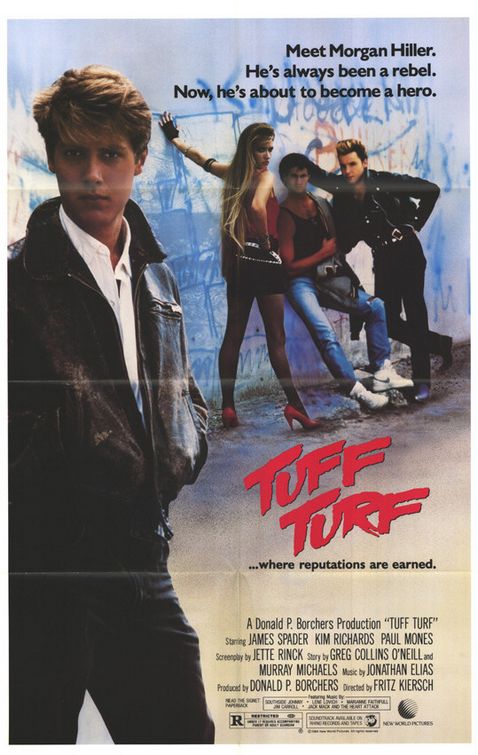
Connecticut country club teen, Morgan (James Spader), moves to L.A. to escape uncertain troubles only to become embroiled in a brutal pissing contest with West Side Story-style flunkie/perpetual senior Nick. Local rock ‘n roll punk (Robert Downey, Jr.) acts as Morgan’s Virgil, helping him navigate L.A.’s moral turpitude. The twist here is that Spader’s outsider isn’t clueless; he’s been through this before and merely underestimates the unlimited supply at Nick’s jerk store. Despite the beatings and bicycle homicide, Morgan falls in love with Nick’s girl, Frankie (the crimped, punky and effervescent Kim Richards before becoming a Real Housewife of Beverly Hills), and faces the timeless teenage dilemma: go after the girl or save himself the hassle. And all this is set to killer 80’s jams.
Tuff Turf isn’t a musical, but it suffers from musical envy. One gets the impression that director Fritz Kiersch has aspirations of combining West Side Story with Footloose. Sometimes he pulls it off. Downey’s new wave/punk band rocks a warehouse dance party. The band, in fact, is the Jim Carroll Band. One might recall Carroll as the author of the 1978 autobiography The Basketball Diaries. Later on Morgan and co. crash a country club with a positively groovy house band. During a set break Spader sidles up to the piano and does some pitchy crooning (his singing voice was laughably dubbed). At one point Spader even stands outside Frankie’s apartment with a little radio, predating Lloyd Dobler by four years.
Eventually the movie takes a predictably earnest turn as Morgan’s extracurriculars encroach upon his family life and he must settle the score with Nick once and for all. You can watch this final third and groan or you can embrace the thrill of badass James Spader and awesomeful dialogue like “I don’t think you can hold onto anything until you let it go.” If nothing else, embrace the fact that this is a movie that would never get made anymore – a silly R-rated teen drama with sex, language, and absurd amounts of violence. Now that I mention it, I have no idea for whom this movie was actually made. 1980’s nostalgists, apparently. Also, I need to find this soundtrack on vinyl. Immediately.
Sidenote: As it turns out, Tuff Turf also predicts Avengers: Age of Ultron. Early in the film, Spader and Downey stand next to a wall with “THE NEW AVENGERS” graffiti scrawled plainly behind them. Neat, right?
Stick

“What’s a boomerang that doesn’t come back? It’s a Stick!”
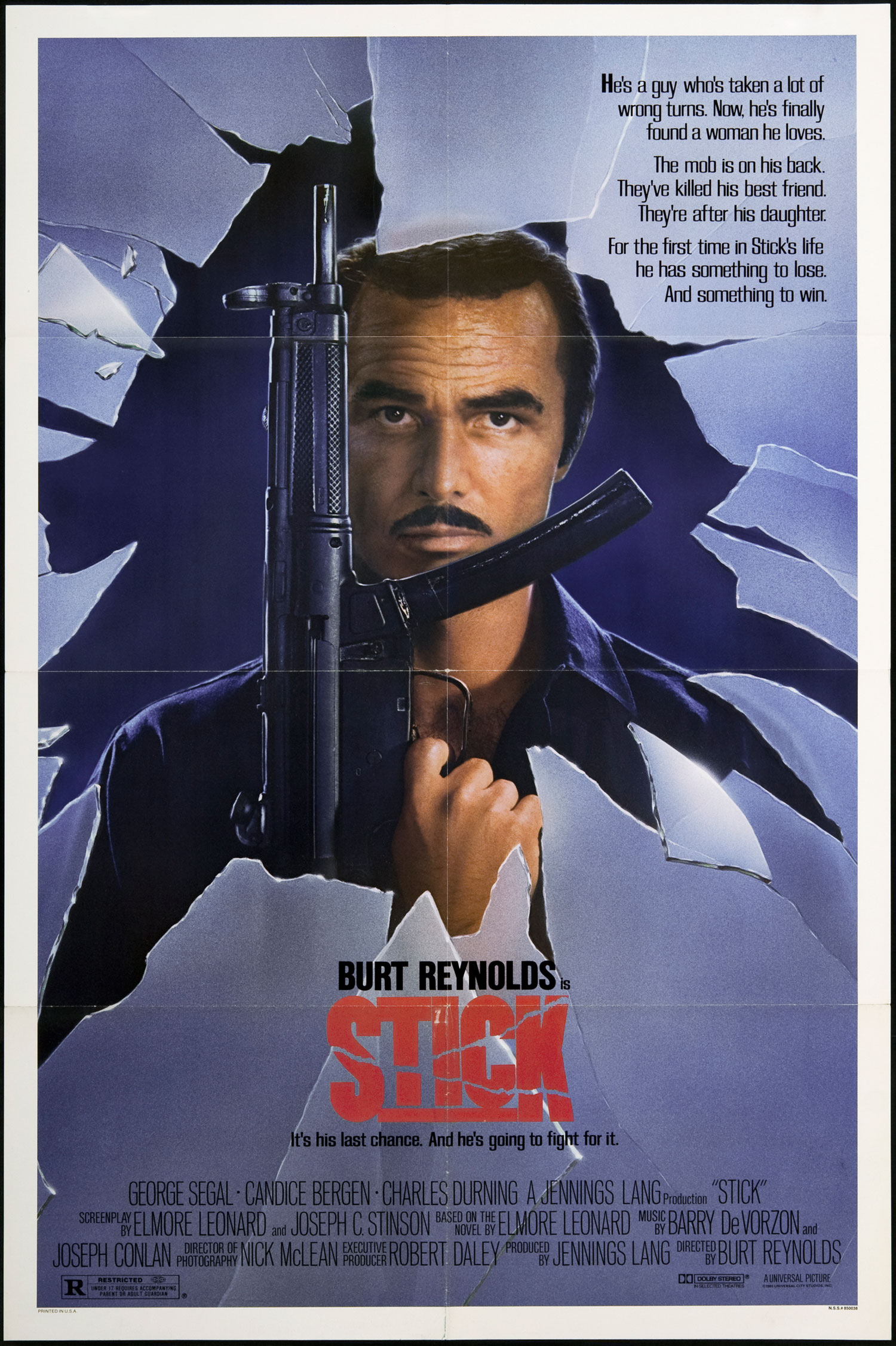
Burt Reynolds made some bad movies in the 1980s. Hell, Burt Reynolds made some bad movies throughout his entire career, and we love him for it. Well, I love him for it anyway. I can’t speak for everyone else. 1985’s Stick ranks among the movies considered Burt’s worst of the worst. I had to sample a few of the “Top” lists on the Interwebs in order to find out just how little regard the general populace holds for Stick. One list put it at number 48. 48! Right next to The Crew.
It’s true that Stick should be better than it is. A script by Elmore Leonard based on a book by Elmore Leonard. A supporting cast featuring George Segal, Candice Bergen and Charles Durning in a orange fright-house wig. Where could Stick go wrong? This might confuse you, but the answer to that last question might just be Burt Reynolds. With his career in a tailspin, Burt was so anxious to spoon feed this surefire hit to the masses that he opted to direct and star in it. So miscast is Burt Reynolds in the role of Stick that after only five minutes, you’ll be off searching IMDB to figure out what numskull cast Burt Reynolds in this film. Trick question. Burt Reynolds cast Burt Reynolds in Stick. Elmore Leonard called this character “Dustbowl farmer turned hobo.” Burt plays stick smarter and much more worldly than he has any reason to be. Stick shouldn’t be a star turn. Can you imagine Burt Reynolds as a Dustbowl farmer?
Reynolds also plays the role straight, without some of the trademark smirk and smarm we’ve come to associate with him. Instead, Burt gives his supporting cast carte blanche to chew scenery and give Stick life. George Segal and Charles Durning are especially snappy as a cigar-chomping dimwit financier and a nefarious baddy with a cast of henchmen and caterpillar eyebrows. Richard Lawson plays another one of George Segal’s help staff and his interracial tête-à-tête with Stick recalls Argyle and John McClane in Die Hard – only more cynical.
Stick makes good use of its gaudy setting in south Florida. There are lots of sweaty humans, swamps, leathery faces, palm trees, scorpions, a synthy score and a chase sequence through a Jai Lai stadium. If we’re playing Miami Bingo, we’re all winners.
Some of the movie’s reputation stems from the behind the scenes troubles. Burt’s face betrays the health problems he had as a result of an accident on City Heat when he was hit in the face with a metal chair. His liquid diet caused him to lose 30 pounds. He was also reportedly addicted to painkillers. After filming concluded, Universal demanded not insignificant reshoots that included the beginning and ending. These reshoots led to Elmore Leonard disowning the film after release. These studio recuts excised Annie Potts from the final cut even after she had a credit on the teaser poster. Nobody cuts Annie Potts and gets away with it.
Despite all this, Burt pulls an entertaining film out of his magic bag of tricks. It might be corny and pulpy in the wrong places, intermittently offensive, and occasionall ill-humored but goshdarnit, Stick plays… if your expectations are reasonably kept in check.
Also, from the “Hell yeah, 1985” files: Anne Murray sings an end-credits theme song over Burt and Candice Bergen talking on wired car phones… until they finally meet up and embrace in a freeze frame.
Water

“Nevermind the pineapple, old sport. Wrap your lips around this.”
Michael Caine first appears in Water in a gaudy Hawaiian print shirt and Dodgers baseball cap, smoking a joint, enjoying the fruits of his homegrown labor. Despite the hundreds, nay, thousands of characters Michael Caine has portrayed in his long career, this entrance remains his finest. Baxter may be his crowning achievement in cinema.
Water contains some pseudo-political sub-plot about British colonialism and big business, but that’s just mashed in to justify making a movie about a forgotten British colony in the Caribbean. Caine runs the island on auto-pilot. His colonial rule is opposed by a local militia (really just Billy Connoly calling himself the Cascara Liberation Front) that sings protest songs, but otherwise doesn’t speak. (“Is that a political posture of speech impediment?”) Rastafarian Jimmie Walker runs the local radio station and pre-dates Robin Williams’ weather reports in Good Morning, Vietnam when he forecasts the Cascaran weather. “IT’S HOOOOOT!”
Conflict arises when the homeland politicos opt to cut off funding to the already impoverished island, and an American drilling company discovers a huge source of natural mineral water. Baxter’s idyllic, pot-smoking, wife-ignoring existence becomes threatened when Cascara becomes the center of everyone’s attention.
Like many great comedies, Water becomes unhinged when narrative gets in the way of good gags… like the fundraising concert spoofing George Harrison’s Concert for Bangladesh featuring the likes of Eric Clapton, George Harrison and Ringo Starr in the Singing Rebels’ Band… or the gestures that accompany the Cascaran national anthem, which mime the various swimming strokes to honor the fact that the island’s inhabitants are descended from shipwreck survivors. If a comedy is measured by the glorious details, Water deserves legions of adoring fans and a much better DVD release that the VHS-dubbed disaster that currently exists.
Restless Natives
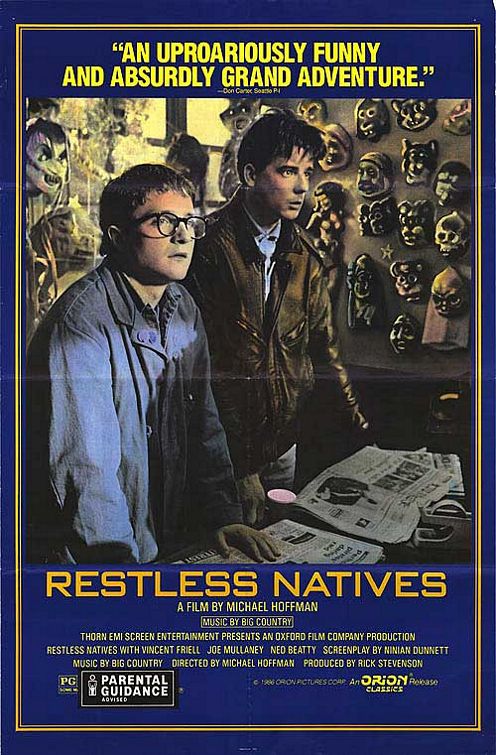
Ronnie: “You see the point is that we’re smarter than they are. “
Will: “I keep getting these funny wee warts on my fingers.”
A light-hearted Scottish flick about bored, broke Scotsmen who start robbing tour buses for something to do and inadvertently become local heroes and celebrities (behind their wolf man and clown masks, anyway). It’s part lighter-hearted Bill Forsyth, part Full Monty, part something else that I can’t quite place… but I’ll get there with enough time to ponder.
…still pondering…
Anyway, don’t think too hard about how Japanese motorcycle manufacturers or local news can track down and capitalize on the infamous Robin Hood/Rob Roy-bus thieves while the local police can’t catch up to them. Like, don’t let it enter your mind, because you’ll start to question things and when you start questioning and thinking you’ll miss out on the tremendous fun to be had with Restless Natives.
Oh and while I’m still pondering, it’s notable that Ned Beatty shows up for a bit. That’s right. THE Ned Beatty.
The lead actors (Joe Mullaney and Vincent Friell) prove to be affable enough and lend some necessary complexity to their characters. The script moves along briskly and efficiently, but it’s the spirit of the film that’ll draw you in. The memorable cinematography of the Scottish hills and moors, the care given to a relatively minor picture, the soundtrack by the Scottish rock outfit Big Country.
Restless Natives is a movie that makes you feel good about movies, the joy of watching an underseen gem, no ironic enjoyment required. Director Michael Hoffman would go on to bigger but not necessarily better Hollywood projects like One Fine Day and Soapdish before scaling back to direct the excellent Game 6. Save this one for a rainy day in need of some levity. In a fair world, this movie might have been revered on a level reserved for Ferris Bueller, but the movie’s appeal never traveled outside Scotland, where it was a local box office success.
The Shmenges: The Last Polka

“The military needed jars. In the summer of 1945 all glass jars in the country were seized, crippling vaudeville in Leutonia.”
This SCTV-produced mockumentary aired on HBO in 1985 and featured characters introduced on the Second City TV sketch comedy program.
Leutonian-born Yosh (John Candy) and Stan (Eugene Levy) are the Shmenges, the biggest polka act in the history of the world. SCTV regulars appear in abundance. Dave Thomas narrates. Rick Moranis plays lounge/polka singer Linsk Minyk. (Minyk and his amazing facial hair deliver a memorable rendition of “Touch Me” by the Doors.) Catherine O’Hara, Robin Duke and Catherine’s sister Mary Margaret appear as one of the many Shmenge collaborators, The Lemon Twins. (The extramarital scandal between the three Lemon sisters and the Shmenges catapults their act to the top of the polka charts.)
It would be easy to liken The Last Polka (a loose parody of The Band’s The Last Waltz) to a polka-cized version of This Is Spinal Tap. The main difference might be that The Last Polka doesn’t try as hard to be funny. Polka, on its own, is just natural comedy; John Candy and Eugene Levy do less mugging than one might expect (and certainly less than Rick Moranis in his pint-sized role) for a polka-based comedy. The mockumentary works best when it’s played completely straight, like when Yosh and Stan take a mid-concert break during a Tuba solo. Romantic close-up on the labored tuba player’s face as he struggles to survive the “break.”
The music’s genuine in The Last Polka, and the laughs are placed there on the stage for you to appreciate. Or not. I certainly found myself watching the entire 55-minutes of The Shmenges: The Last Polka with a huge smile on my face. The joy culminates in a Shmenge tribute to Michael Jackson complete with a Polka version of “Beat It.”
The Last Polka has never been released on DVD, and the VHS is becoming a little difficult to find. Lucky for us all, an enterprising soul has put the comedy on Youtube, thus preserving, at least temporarily, the Shmenges’ legacy.
Transylvania 6-5000

“Master, I’ve had enough aggravation for one day.”
Here’s a tip: Lifeforce/Transylvania 6-5000 double feature. Truly. There’s a certain symbiosis in the Lifeforce and Transylvania 6-5000 pairing. Not only do the two films share the same 1985 release year but also wacked notions of what vampires can be if we forget the Dracula kind for a moment. Of course there’s a far cry from space vampires to Geena Davis… but somehow Geena Davis still takes the prize for oddness.
Critics ripped this movie to bits and, well, it has a certain infamous reputation. Reputations be damned. If the movie features Jeff Goldblum, Michael Richards, Geena Davis, and Carol Kane it’s worth watching… on some level. Of course it’s dumb. Of course, many of the jokes try too damn hard. But this was the 80’s when movies knew how to have a 5 IQ and still reward with creative ineptitude and brilliant character actors just doing pratfalls. Carol Kane just being Carol Kane. Ed Begley, Jr. in a starring role! Jeff Goldblumage off the charts.
Instead of attempting to explain why this movie is worth watching or why it doesn’t exactly deserve it’s reputation — I’m not sure there’s a legitimate argument other than joie de vivre! — I’ll just make this movie another entry in the “Why I Love the 1980’s” coffee table book, which I’m quite sure will convince you all that the 80’s were, like, ohmygod, the best decade ever for amazingly fun bad movies.
Honorable Mention 5-Pack:
Remo Williams: The Adventure Begins
Trouble in Mind
The Man with One Red Shoe
Secret Admirer
Mr. Vampire